BGD is a one-stop B2B/B2C perfume sourcing platform offering the highest quality most comprehensive product range and the safest partners...


How AI Will Create Soul Fragrance: The Next Breakthrough in Beauty for 2027

Artificial intelligence is reshaping virtually every consumer industry, and beauty is no exception. The companies that successfully integrate AI into product development, customer experience, and supply chain optimization will define the next generation of market leaders.
According to McKinsey’s beauty industry analysis, personalization is emerging as one of the most powerful drivers of future growth. Consumers increasingly expect products that reflect their identities, lifestyles, and emotional needs rather than generic mass-market solutions.
Fragrance may be the category with the greatest untapped potential. While skincare and cosmetics have already embraced AI-powered personalization, perfume remains largely rooted in traditional market segmentation and trend forecasting.
This creates an opportunity for a new category: Soul Fragrance — a scent designed not for the average consumer, but for the individual.
What Is Soul Fragrance?
Unlike conventional perfumes designed around broad commercial appeal, Soul Fragrance acts as an olfactory reflection of personality, memory, emotional state, and even skin chemistry.
Rather than asking what smells good to the market, Soul Fragrance asks a more personal question:
What does an individual smell like emotionally?
A Soul Fragrance is more than a pleasant scent. It is an invisible extension of identity — a personalized olfactory signature that captures who someone is, where they have been, and how they want to be remembered.
Recent advances in multimodal AI make it increasingly possible to translate abstract inner experiences into structured fragrance compositions, opening a path toward truly individualized scent creation that mass-produced perfumes can never replicate.
From Art to Science: The Rise of Algorithmic Perfumery
The concept of AI-generated fragrance is no longer purely theoretical.
Recent research in algorithmic perfumery has explored how machine-learning systems can model relationships between personality traits, emotional preferences, and fragrance structures. Researchers have proposed adaptive frameworks capable of linking psychological profiles to scent architectures, creating a scientific foundation for AI-assisted fragrance creation.
In other words, fragrance personalization is evolving from subjective intuition into a data-informed discipline.
As AI becomes increasingly capable of interpreting human emotions, memories, sensory preferences, and behavioral patterns, fragrance creation can move beyond trend-driven formulas toward deeply personal scent experiences.
Building a Complete Soul Personality Profile Through Multimodal AI
Traditional fragrance recommendation tools typically ask simple questions such as:
“Do you prefer floral or woody scents?”
An AI-powered Soul Fragrance system goes much further.
Instead of relying solely on fragrance preferences, it gathers multi-dimensional sensory information to construct a comprehensive emotional and personality profile.

NLP-Based Deep Personality Assessment
Using advanced psychological modeling and natural language processing, AI analyzes four foundational pillars.
1. Core Personality Identity
- Introverted and reflective
- Free-spirited and adventurous
- Romantic and gentle
- Minimalist and refined
- Dark and mysterious
2. Memory-Linked Scent Anchors
AI identifies meaningful scent memories associated with:
- Childhood experiences
- Life-changing moments
- Favorite seasons
- Travel destinations
- Family traditions
3. Lifestyle Rhythm
Daily routines shape fragrance behavior.
Examples include:
- Professional work environments
- Outdoor activities
- Social occasions
- Private evening rituals
- Frequent travel
4. Desired Emotional Presence
Users may wish to project:
- Confidence and authority
- Warmth and comfort
- Nostalgia and sentimentality
- Creativity and individuality
- Modern sophistication
Large language models analyze these inputs and map them to fragrance ingredients through a Personality-to-Olfactory database, identifying scent families most aligned with the individual’s emotional profile.
Image, Audio, and Biometric Inputs
Future generations of multimodal AI can extend far beyond text.
Image Uploads
Users may upload meaningful photos such as:
- Childhood homes
- Travel destinations
- Natural landscapes
- Family memories
AI analyzes environmental cues and translates them into scent descriptors such as:
- Sea salt
- Pine smoke
- Citrus groves
- Fresh rain
- Wild herbs
Audio Uploads
Favorite playlists, voice recordings, or spoken memories provide additional emotional context.
AI evaluates:
- Tempo
- Mood
- Energy levels
- Emotional tone
and converts them into fragrance accords.
Biometric Data (Premium Services)
Advanced systems may integrate data from wearable devices, including:
- Stress and relaxation levels
- Heart-rate variability
- Skin pH
- Skin oil content
- Body temperature
These measurements allow AI to calibrate fragrances not only emotionally but physiologically.
AI-Designed Olfactory Architecture
Once the Soul Profile has been completed, generative AI constructs a fragrance architecture in which every ingredient serves a specific emotional purpose.
Rather than randomly combining popular ingredients, AI builds a structured four-layer scent identity.
Layer One: Soul Foundation
Longevity: 6–12 Hours
The foundation layer represents the wearer’s enduring inner character.
Examples include:
Reflective Personalities
- Creamy Sandalwood
- Labdanum
- Tonka Bean
Independent and Adventurous Personalities
- Smoked Oud
- Deep Patchouli
- Aged Cedarwood
Minimalist Personalities
- White Amber
- Driftwood
- Dry Moss
This layer becomes the emotional anchor of the fragrance and rarely changes.
Layer Two: Emotional Rhythm
Longevity: 2–6 Hours
This layer reflects daily lifestyle patterns and emotional balance.
Professionals
- Soft Peony
- Fig Leaf
- Gentle Lavender
Outdoor Enthusiasts
- Wild Mint
- Green Tea
- Pear Blossom
Evening Wear
- Jasmine
- Osmanthus
- Ripe Plum
These notes adapt the fragrance to everyday experiences while maintaining harmony with the soul foundation.
Layer Three: Personal Expression
Longevity: 0–2 Hours
The opening notes shape first impressions and social perception.
Bright and Confident
- Blood Orange
- Mandarin
- Pink Pepper
Soft and Dreamlike
- Lychee
- Bergamot
- Honeysuckle
Modern and Cool
- Blackcurrant
- Sea Salt
- Vetiver
This layer communicates the image users wish to project to the world.
Layer Four: Memory Signature Layer
This is the defining feature that separates Soul Fragrance from conventional customization.
AI introduces trace amounts of memory-linked ingredients that serve as unique emotional markers.
Examples:
Childhood Memory of an Italian Lemon Orchard
- A delicate touch of Verbena
Winter Cabin in the Mountains
- A subtle pine smoke accord
Rainy Summer Afternoons
- Damp earth and green leaves
These scent signatures function as olfactory fingerprints.
No two users receive exactly the same memory-accent combination.
AI Adapts Fragrance to Skin Chemistry and Regional Preferences
Even the most emotionally accurate fragrance can fail if it conflicts with skin chemistry.
AI continuously optimizes formulas according to physiological characteristics.
Oily Skin
- Reduce excessive vanilla and musk
- Increase dry woody materials
- Improve scent stability
Dry Skin
- Add Benzoin and Myrrh resins
- Enhance fragrance retention
- Preserve floral heart notes
Sensitive Skin
AI cross-references international allergen databases and automatically replaces potentially irritating ingredients with safer alternatives.
The emotional identity of the fragrance remains intact while technical adjustments ensure optimal performance.
AI can also make subtle modifications for regional scent preferences without altering the wearer’s core fragrance profile.
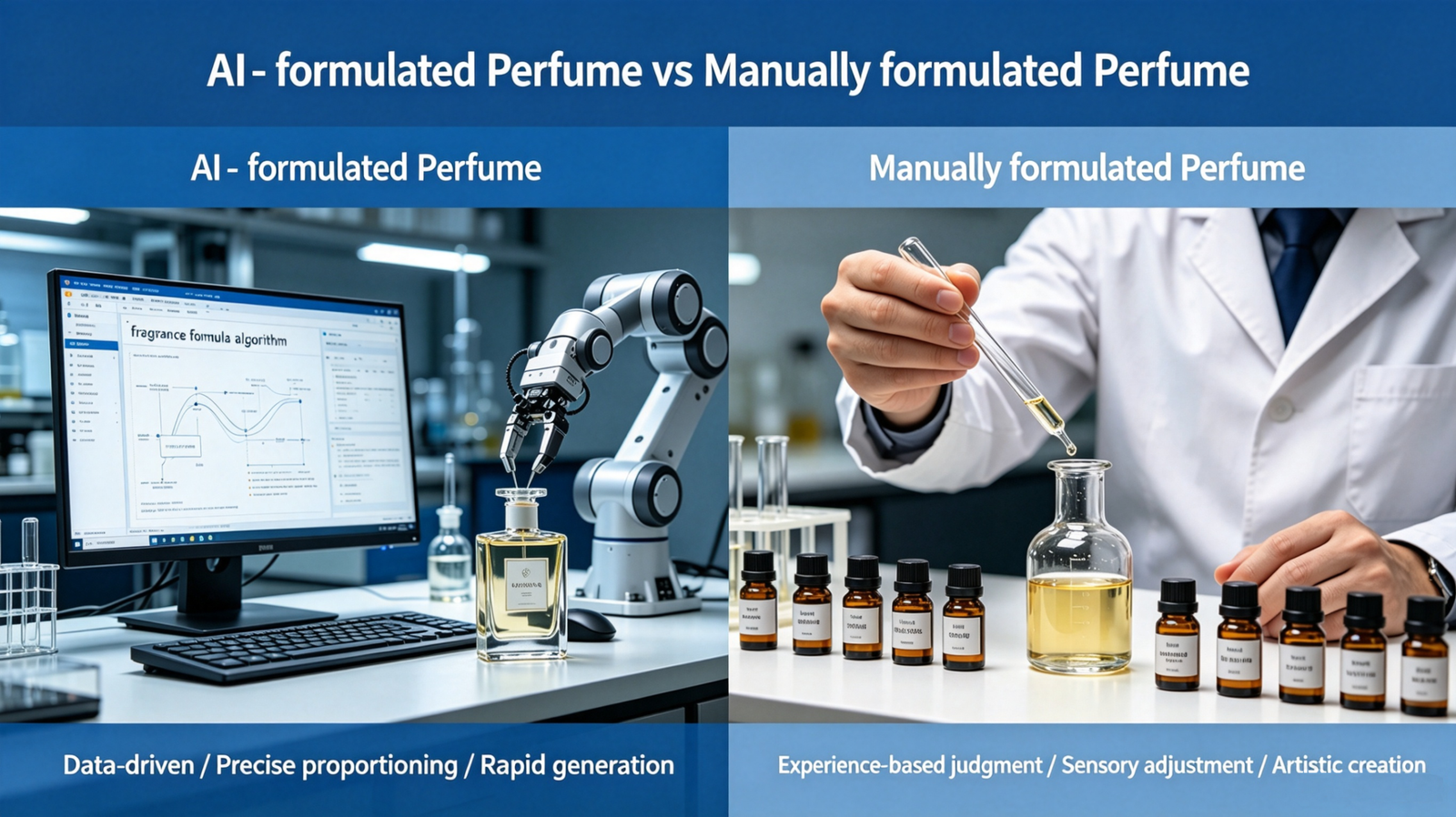
AI Validation + Human Perfumery Expertise
AI will not replace perfumers.
Instead, the most effective model combines computational precision with human artistry.
AI Technical Validation
Within seconds, AI can perform thousands of evaluations:
- Safety screening
- Allergen detection
- Regulatory compliance checks
- Evaporation simulations
- Longevity forecasting
- Sustainability analysis
- Raw material optimization
- Carbon footprint calculations
Human Artistic Refinement
Experienced perfumers contribute elements that algorithms cannot fully replicate.
They:
- Fine-tune memory-linked ingredients
- Improve emotional transitions
- Balance warmth and freshness
- Adjust projection and diffusion
- Strengthen storytelling and atmosphere
The result is a collaboration between artificial intelligence and human creativity.
Digital Scent Testing and Continuous Iteration
One of the most exciting opportunities for future fragrance brands lies in virtual scent experiences.
Home-Based Digital Sampling
Consumers may use connected scent devices capable of recreating fragrance formulas before purchase.
This dramatically reduces the need for physical samples.
Instant Formula Updates
If users dislike a specific note or layer, feedback can be submitted directly to the AI system.
The formula can be recalibrated within minutes, generating new fragrance variations almost instantly.
Lower Costs for Global E-Commerce Brands
For Shopify stores, DTC brands, and international fragrance companies, virtual scent testing could significantly reduce:
- Sampling costs
- International shipping expenses
- Product return rates
- Development timelines
Why AI Soul Fragrance Outperforms Traditional Bespoke Perfumery
1. Personal Story Becomes the Creative Foundation
Every formula begins with the user’s memories, personality, emotions, and experiences rather than the subjective preferences of a perfumer.
2. Luxury-Level Personalization at Accessible Pricing
Traditional bespoke perfumery can cost hundreds or even thousands of dollars.
AI automation has the potential to make personalized fragrance available to a much broader audience.
3. Infinite Personalization Possibilities
AI can process millions of scent-memory relationships and generate virtually unlimited combinations that no human perfumer could manually manage.
4. Built-In Skin and Cultural Adaptation
Personal skin chemistry, climate conditions, and regional scent preferences become standard inputs rather than afterthoughts.
Looking Ahead: From Personalized Fragrance to Digital Identity
The future of fragrance is unlikely to be defined solely by celebrity endorsements, seasonal launches, or mass-market trends.
As AI becomes increasingly capable of understanding personality, emotion, memory, and physiology, scent may evolve into an entirely new form of personal identity technology.
Just as music became personalized through recommendation algorithms and digital experiences became individualized through machine learning, fragrance is entering an era where every formula can be uniquely generated for a single person.
Soul Fragrance represents the convergence of artificial intelligence, psychology, sensory science, and perfumery.
It transforms fragrance from a product into a personal narrative.
For global fragrance brands, AI-powered scent personalization is no longer simply an innovation opportunity. It may become the defining competitive advantage of the next decade.
The brands that succeed in the AI era will not merely sell fragrances.
They will help consumers wear their stories.
This article is from www.baoguoda.com All rights reserved.